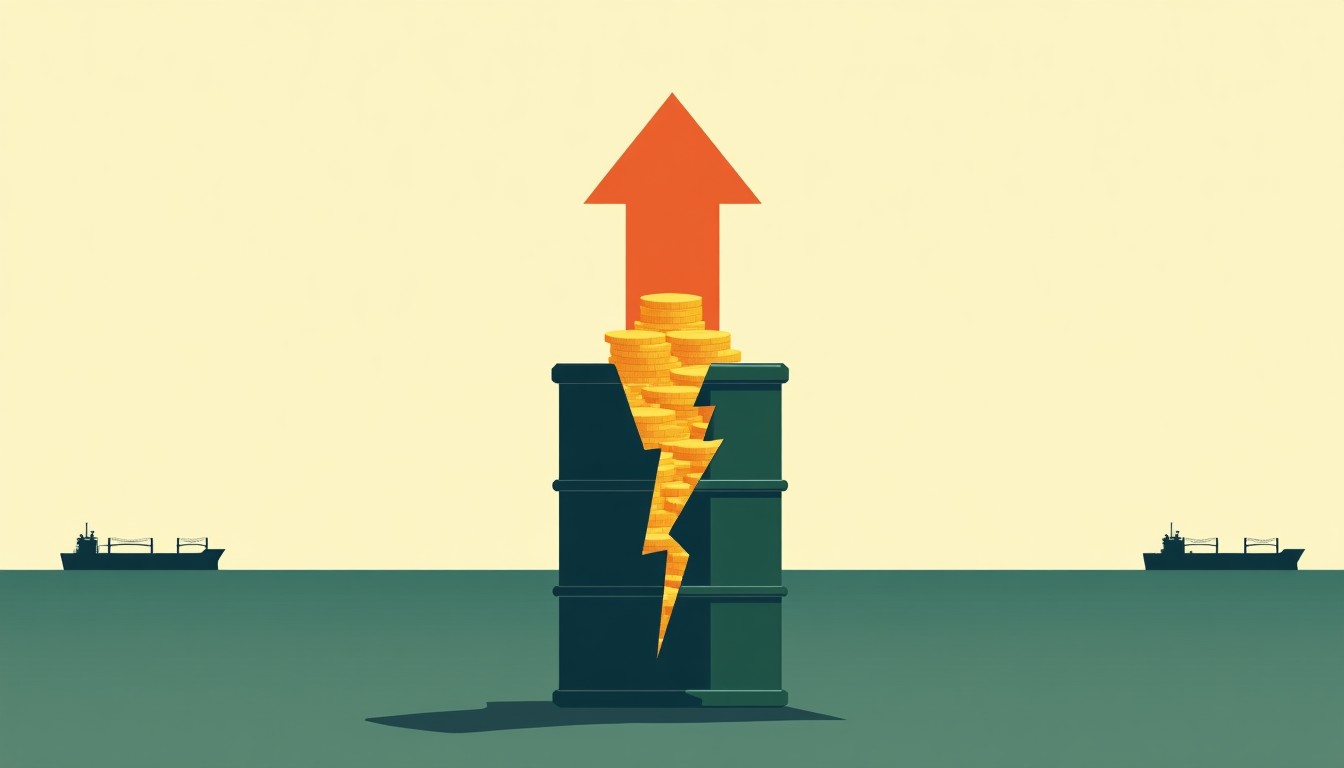
Daily tanker charter rates have crossed $1 million for the first time on record, a milestone that pushes physical crude costs higher just as vessels themselves become targets for cyberattacks.
The numbers behind the spike
Baltic Exchange data shows tankers loading crude inside the Persian Gulf commanded $1.035 million per day this week. The same run from the Gulf of Oman, outside the Strait of Hormuz, fetched $644,000. Both figures reflect a market where owners willing to transit the strait are scarce, and the premium for that willingness is now measured in seven figures.
Black Sea pressure adds to the squeeze
The tightness is not confined to the Middle East. At Novorossiysk, Aframax rates to West India and North China rose for a seventh consecutive week in the period ending September 6, climbing 2.7 percent and 3.1 percent respectively from the prior week. Ukrainian drone attacks on vessels and port infrastructure are the stated driver, keeping Black Sea tonnage on edge.
Inventories tell a different story
While the U.S. Energy Information Administration reported a build of more than 7 million barrels last week, the International Energy Agency counted a 95 million barrel draw in global observed stocks for August alone. Since February the cumulative deficit reaches 507 million barrels, roughly 2.8 million barrels per day. Oil on water has also fallen by 65 million barrels as Hormuz attacks reduce floating supply. The Saudi East-West pipeline remains offline, potentially for weeks, after a drone strike.
Cyber risk enters the calculus
U.S. federal authorities are investigating a possible cyberattack on at least two tankers, one carrying crude, the other liquefied gas, that arrived at the Gulf Coast in August. The Wall Street Journal, citing unnamed officials, said the compromise occurred near Gibraltar, a choke point handling roughly 300 ships daily. Rear Admiral Jason Tama, head of the Coast Guard’s Cyber Command, warned that hackable software managing tank atmospheres could trigger fire, explosion or spill.
Buyers turn to ownership
Charter costs and soaring insurance premiums are pushing some energy players to purchase second-hand tonnage instead of renting. Used vessel valuations have risen past newbuild prices since the strait closure, a rare inversion that signals owners expect the disruption to persist.