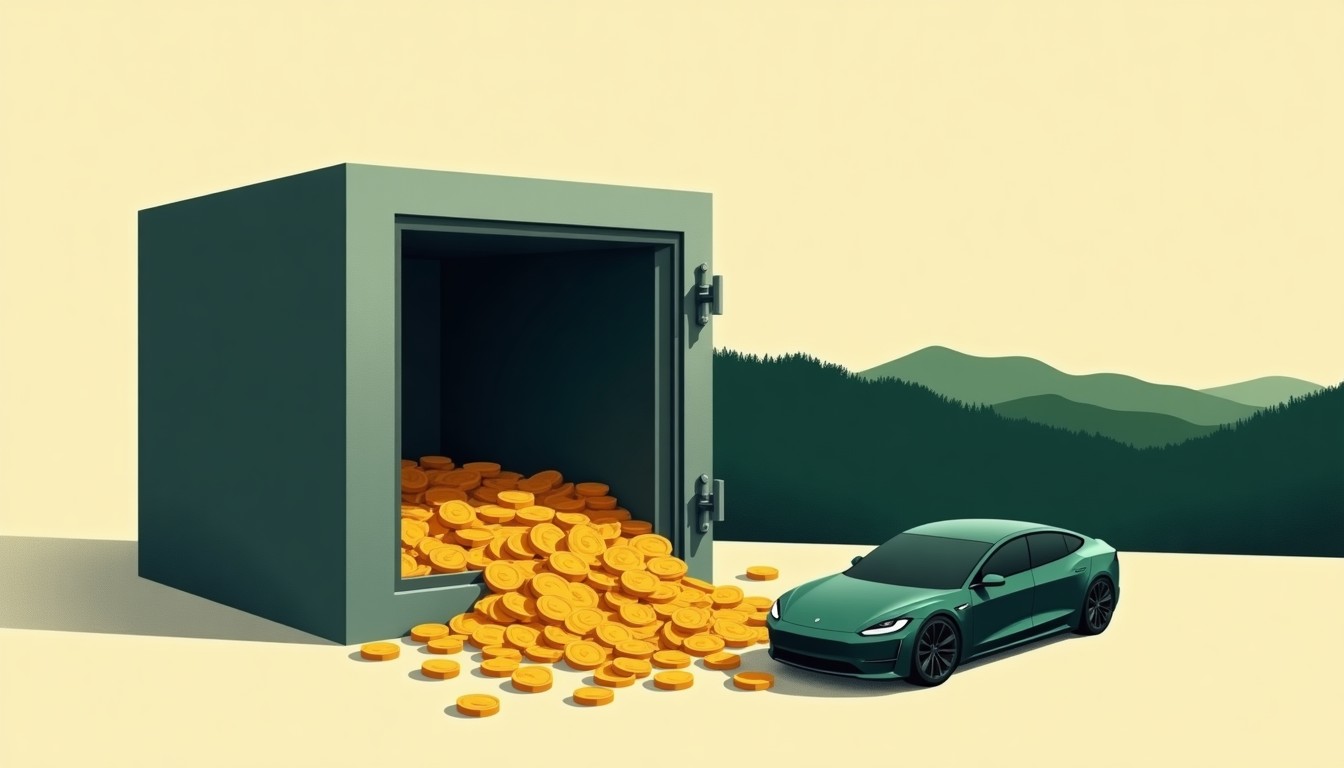
Tesla is planning a capital expenditure binge that would make most automakers blush, telling investors to expect more than $25 billion in spending this year even as free cash flow swung to a negative $1 billion last quarter. The figure landed on the second-quarter earnings call where Elon Musk labeled 2026 a “massive capex year” and CFO Vaibhav Taneja laid out a shopping list, Robotaxi fleet, Optimus humanoid robots, a semiconductor fab, solar manufacturing, AI compute infrastructure, that he said will keep capex growing for the next two or three years.
The numbers are already moving fast. Quarterly capex jumped 142 percent year over year to nearly $6 billion, and that surge was the primary reason free cash flow plummeted 848 percent to about negative $1 billion, Taneja said. GAAP net income slipped 5 percent to $1.1 billion. The market noticed: shares fell roughly 14 percent on Thursday after the report.
Musk and Taneja argued the outlay is deliberate. “I’m confident that all the things we’re investing in will yield incredible returns,” Musk said. Taneja added that Tesla is being “opportunistic” in locking up to $30 billion in borrowing capacity, framing the strategy as positioning for the “next era” while acknowledging progress will be “non-linear.” The company also exited the quarter with its largest order backlog since 2023.
The robotaxi narrative, however, has grown more cautious. Musk struck a noticeably different tone than in previous quarters: “We don’t want to injure anyone. We’re going as fast as humanly possible in scaling Robotaxi, but while trying to ensure that we do not harm anyone at all, and ideally do not even run over a pet.” The service now operates in seven U.S. markets, and Cybercab test drives have begun, but expansion has been slower than originally projected.
That gap between projection and reality is now a legal matter. Tesla, Musk, Taneja and former CFO Zachary Kirkhorn face a class action suit filed last August in Texas alleging they understated robotaxi risks. A Florida jury ordered the company to pay $240 million to victims of an autopilot-related crash in August 2025. The California Department of Motor Vehicles separately found Tesla used “autopilot” and “full self-driving” misleadingly in 2025.
One bright spot executives highlighted was Tesla’s link to SpaceX, which went public in June in the largest initial public offering in history at a valuation of nearly $2 trillion. Whether that connection translates into tangible operational leverage remains an open question. For now, the capex curve is steep, the cash flow is negative, and the robotaxi fleet is growing, carefully, expensively, and under a microscope.