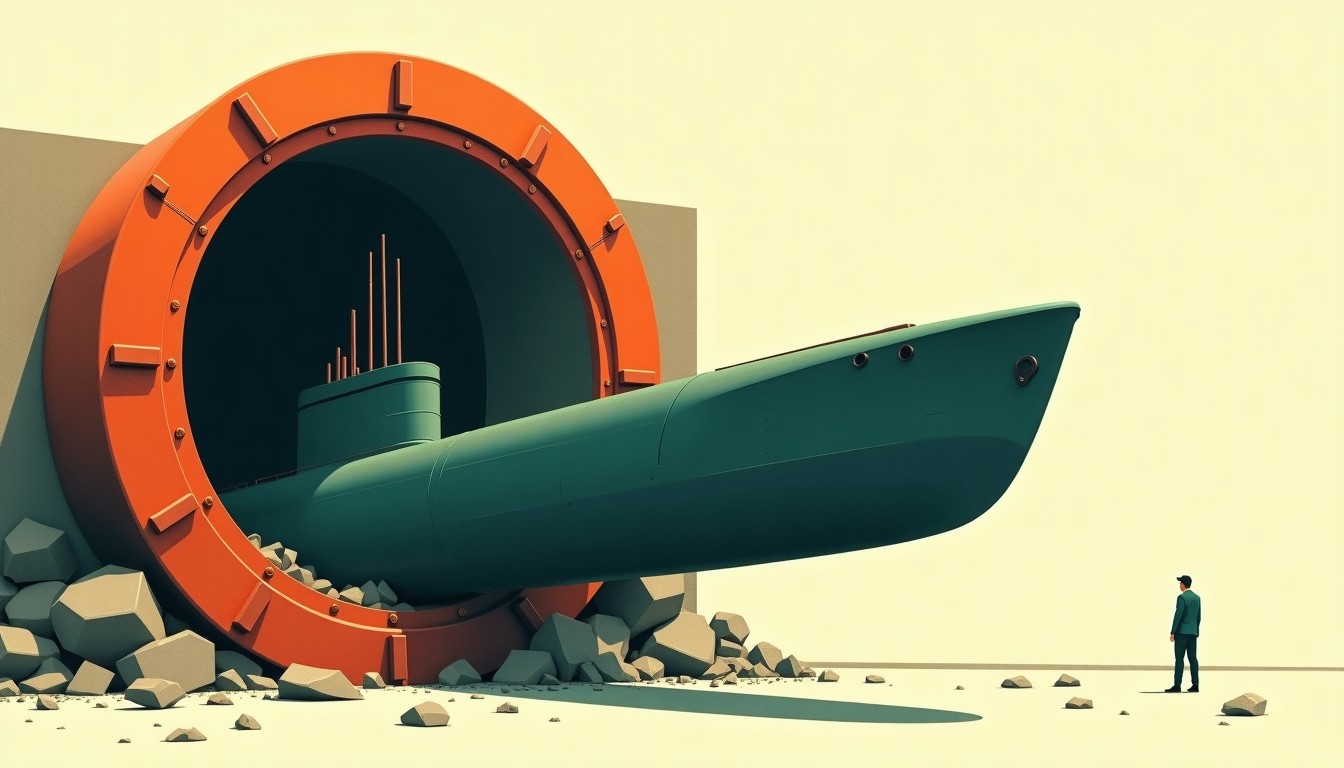
The US Navy has put $76.6 billion on the table for 14 new submarines and the industrial base required to build them, a single-day commitment that dwarfs the annual GDP of several small nations and signals Washington's attempt to arrest years of schedule slippage in its most critical undersea programs.
The split tells the story
Five Columbia-class ballistic missile submarines account for roughly $30 billion of the total, while nine Virginia-class Block VI attack boats consume the remaining $42 billion. Both lines go to the same two contractors, General Dynamics Electric Boat and Huntington Ingalls Industries, who have spent the past decade explaining to Congress why the most advanced submarines in the world keep arriving late and over budget. The Navy's own release acknowledges that portions of the Block VI award and the shipyard productivity investments were already announced, meaning the genuinely new money is smaller than the headline figure suggests.
China's shadow looms over the shipyard
Vice Adm. Robert Gaucher framed the awards as ensuring "continuous production" of the world's most lethal combat platform while providing "long-term stability" to the industrial base. The subtext is impossible to miss: China's fleet has grown larger than the US Navy's by hull count, and its newest submarines are closing the technology gap. The Pentagon's solution is volume, nine Virginias in one block buy, five Columbias in a steady drumbeat, but volume only works if the yards can actually weld hulls faster than they have been.
Workforce is the bottleneck nobody wants to name
Shipbuilders have spent years arguing that unpredictable Navy orders make it impossible to hire, train, and retain the welders, electricians, and nuclear-qualified technicians a submarine requires. The Navy's answer this time includes explicit workforce investments, better pay, benefits, housing support, and automation pilots. Whether that solves the experience drain or merely papers over it with overtime budgets remains an open question. The presidents of both Electric Boat and Newport News Shipbuilding issued statements welcoming the "demand signal," which is contractor speak for "we can finally borrow against a predictable backlog."
The quiet pivot to allied yards
Buried in the broader context is the Navy's deepening reliance on South Korean and Japanese shipyards for maintenance and repair work. South Korean yards, described in the release as "some of the most advanced and busiest in the world," are already conducting more upkeep on US Navy vessels. That is not a partnership of equals, it is an admission that domestic capacity, even after $76.6 billion, cannot meet the operational tempo the Indo-Pacific strategy demands. The next budget fight will not be about how many submarines to buy, but whether the yards building them are in Connecticut, Virginia, or Geoje.