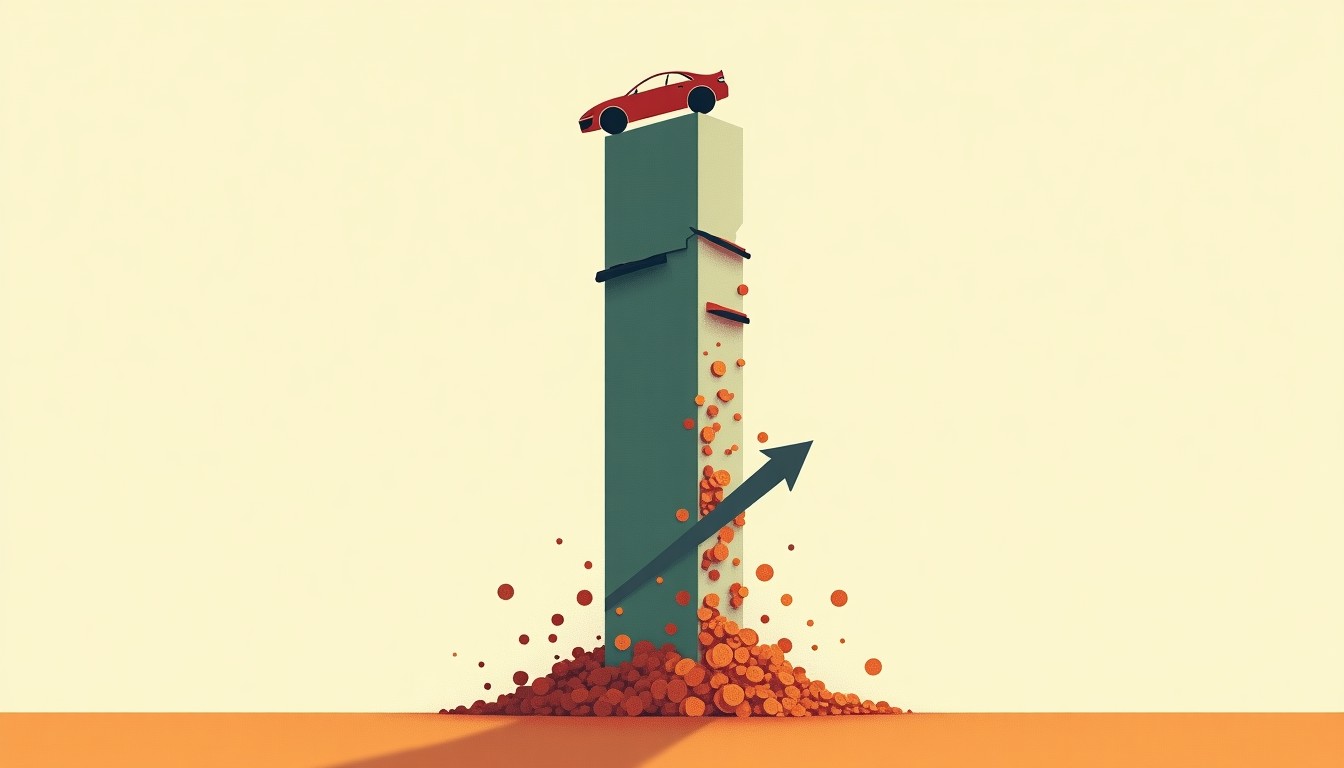
China's passenger vehicle market is on track for its worst year since 2021, with first-half sales plunging 20.2% and the industry's own association cutting its full-year forecast to a 14% decline, a brutal reset after 2025's record 23.7 million units. The China Passenger Car Association now sees 20.4 million deliveries for 2026, down from its earlier call for flat sales, with cumulative volume through June stuck at 8.7 million units.
The rot runs deeper than the headline. Retail sales of internal combustion vehicles collapsed 39% year-on-year in June, pure gasoline models down 42%, accounting for 78% of the total passenger vehicle decline that month. Transportation energy costs surged 15.3% over the same period, according to the National Bureau of Statistics, while Beijing's withdrawal of new-energy vehicle subsidies removed the policy prop that had pulled forward demand. "Policy only moves demand around," Citic CLSA's Xiao Feng told CNBC, arguing the current slump is largely payback for 2025's frontloaded purchases. He sees the full-year drop at 20%, not 14%, though he expects NEVs to limp down only 5% to 6%.
Margins tell the real story. Industry sales profit margins cratered to 3.4% for January through May, with profits down 20% year-on-year, per CPCA Secretary General Cui Dongshu. Battery input costs, lithium, memory chips, are rising sharply even as average passenger vehicle prices fell more than 1% in June. The squeeze is existential: Feng calculates a Chinese carmaker needs 500,000 annual units to break even, 1 million for sustainable profits, and 2 million for full economies of scale.
The survivors are already visible. BYD delivered 1.8 million units in the first half, Geely 1.4 million, Leapmotor 356,000. Volkswagen Group managed 973,000, down 25.9% despite its electric pivot, while Toyota posted 579,000 through May. Feng predicts the market consolidates to seven or eight players by 2030, with US brands exiting entirely and the remainder split between domestic giants, Volkswagen, and Toyota.
What matters now is whether the second half stabilizes or accelerates the shakeout. Feng expects the downturn to persist. With subsidies gone, energy costs rising, and prices falling, the industry is being forced to earn its keep on product and cost discipline alone, a test most will fail.