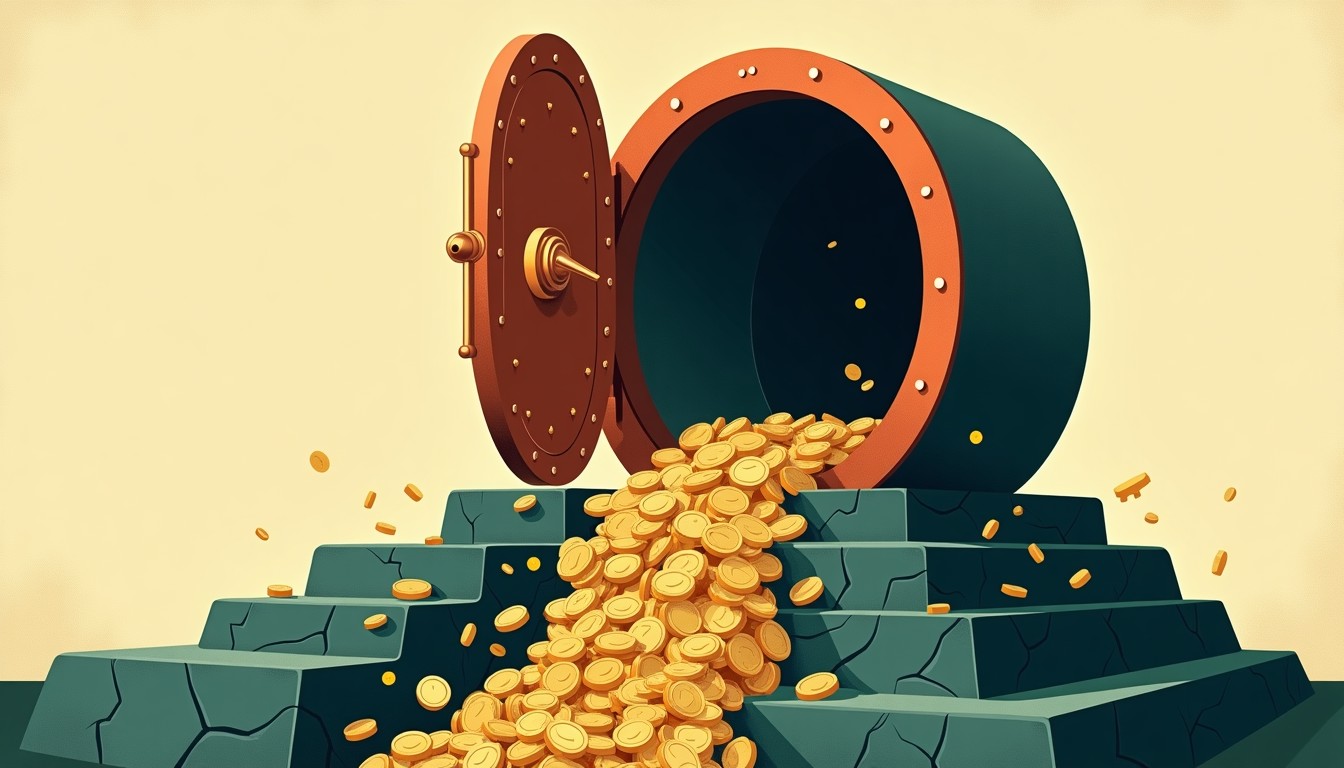
Alphabet shares dropped more than 7 percent Thursday after the company raised its 2026 capital expenditure ceiling to as much as $205 billion, a jump that pushed the stock into negative free cash flow and dragged the rest of the Magnificent Seven down a combined $888.2 billion in market value by midday. The parent of Google reported second-quarter revenue up 24 percent year over year and cloud revenue up 82 percent to $24.8 billion, broadly beating expectations, but the market treated the earnings beat as a footnote to the spending plan.
The new capex target represents a significant increase from the $180 billion to $190 billion range projected just three months ago, and Chief Financial Officer Anat Ashkenazi told analysts the ramp would increase significantly again in 2027. The vast majority of that outlay goes to data centers and the computing equipment inside them, a bill now large enough to exceed the cash the business generates. Leadership acknowledged the negative free cash flow is likely to persist for the foreseeable future, a rare admission for a company of this scale.
Management framed the splurge as a reaction to demand rather than a speculative bet. Ashkenazi pointed to a cloud backlog that swelled by roughly $50 billion between the first and second quarters as evidence that computing capacity still trails customer needs. Chief Executive Sundar Pichai called these the very early days of AI and argued the dynamics look healthier than a year ago, suggesting that operating at a loss today to secure cloud share will more than pay for itself as the AI economy expands.
MoffettNathanson analyst Michael Nathanson countered that the road looks bumpier as competition and capital ramp to once unimaginable heights. The selloff spread instantly to Amazon, Apple, Meta, Microsoft, Nvidia and Tesla, turning Alphabet’s specific guidance update into a sector-wide confidence test. Analysts noted the market was still digesting the previous spending trajectory; the sudden step-up suggests the cost of staying relevant in AI is accelerating faster than the revenue proof points.
The deeper worry, only half-voiced in the research notes, is that Google may be getting less output per dollar of silicon than its peers. The cloud growth number is strong, but the backlog surge implies a capacity deficit that competitors like Microsoft and Amazon appear to be managing with less dramatic capex revisions. If the arms race is about efficiency as much as scale, the company spending the most to catch up may be the one with the weakest position.
What matters now is whether the 2027 ramp materializes on schedule and whether free cash flow inflects before the market loses patience with the math. The Magnificent Seven trade has always been a bet on monopoly-like returns; watching the most profitable search engine in history voluntarily turn into a capital-intensive utility is a strange spectacle, even if the strategic logic is sound.